Posts

Learning Map

Here is my assignment 2A, where we were required to create a Learning Map for the week in which we are working out how our one day of teaching is situated within the grading period and within the unit.  The learning product for this module is the Birthday Polynomial Project (adapted from another blogger) is in the next post.  Worksheet Steps  1-10* Step Activity Grading Period Content Planning Find 9 concepts:  Structures of Expressions Quadratic Equations Functions and Their Features Geometric Figures Similarity and Right Triangle Trigonometry Circles Conics Logarithmic Functions Polynomial Functions Unit/Week Organization Select one week’s concept (big idea) to use as content: Polynomial Functions Divide content into 5 Minor Content Areas (5 smaller ideas) one for each teaching day:  Operations on Functions Binomial Expansion End Behavior Determining Roots of Polynomials Features of Polynomials Scope & Sequence ...
Warm-up Activity

For Discussion 2B, my warm-up is similar to these  Diamond Problems . The worksheet is close of a warm-up activity I normally do. I usually do not give out a worksheet, I just make up my own numbers depending on what I want the students to work on for the upcoming lesson. I then write the diamond problems on the board and have the students copy them into their workbook. I start with numbers on either side and tell the students to write their product on top and their sum on bottom. After they practice that, I give them the inverse, ask them to find the two numbers that yield a given product and sum. This warm-up activates prior knowledge because students will need to be able to add and multiply integers in order to factor, but they are not being asked to factor yet. I am simply making sure that students can determine the numbers that they will soon use in a factorization. Since it is pretty easy for students at the 10th grade level, it builds their confidence and gets them ...

Teaching Mathematics with Videos

For Discussion 2A, I chose the following video: https://www.khanacademy.org/math/ap-calculus-ab/riemann-sums-ab/rieman-sums-tut-ab/v/simple-riemann-approximation-using-rectangles I chose a video from Khan Academy. I often use Khan Academy, not as a replacement for instruction, but as a supplement. I use it for students who are absent, need a quick refresher of a topic, or cannot understand my instruction. I have especially chose this video because I have used it before. This past school year was my first year teaching AP Calculus, which has presented me with a slew of new challenges.  Riemann sums, the topic of this video are not the most difficult topic in Calculus, but I found it difficult to model. As shown in the video, it is very visual and requires a lot of drawing. This proved difficult for me on the white board, where i often messed up the exact points on the graph, the shape of the graph, or the straight lines needed. Though I tried to do it on my own, this video re...

Learning Map

Here is my Learning Map for Assignment 1B. I know that the assignment says to use the map we made in TED 632, but that was over a year ago for me and I didn't like it, so I made a new one. I used the last week of school that I taught, where my Integrated II students were getting a jump on Integrated III/Precalculus topics. I had some difficulty coming up with the real world applications, because polynomials tend to be a bit abstract for these students. Though it didn't go into any of these real world applications, one that we often talk about is roller coasters. polynomials can be written to represent the same of roller coasters to help designers and physicists accurately create safe and fun coasters.  Day of the Week Day 1 Day 2 Day 3 Day 4 Day 5 Essential Question When we add functions, do we still have a function? Of the same degree? What about when we multiply functions? Do we have to factor (x+1) raised to the 6 five time...

Teaching Style

Image
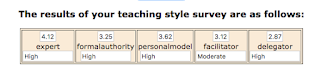
To be honest, I don't feel that Grasha's Teaching Styles Inventory was very illuminating to me. Maybe it was just the way that I answered all the questions, but I felt that it didn't really tell me how I taught. All the answers seemed to be close, but it deemed some of the areas high even though the number seemed low. Maybe this doesn't make sense to me because I am more of a visual learner (see previous post) and it didn't include a diagram. Or because I am a mathematical person who relies on number sense and objectivity and the quiz deemed a 2.87 High while a 3.12 Moderate (see the post before the previous one). Regardless of the scoring system, the quiz seems to have identified my teaching style as "Expert." This actually makes sense to me because I am quite good at math (I have yet to see the word " humble" appear in any of my questionnaire results). My degree is in mathematics and I am currently working to get my Masters in Mathematics...

Learning Style

Image
According to a learning style quiz available at https://www.webtools.ncsu.edu/learningstyles/ there are four continuums of learning: Active vs. Reflective, Sensing vs. Intuitive, Visual vs. Verbal, and Sequential vs. Global. Upon taking this quiz, I found that I am pretty well balanced in the first, second, and fourth continuum leaning slightly toward active, sensing, and global, respectively. The main area that I seem very unbalanced in is Visual vs. Verbal. According to this test, I almost completely favor a visual learning style over a verbal one. This means that I prefer diagrams, photos, and maps over things like text and explanations.  Fortunately, I do not think that this will be a huge issue for most of my students. As one can expect, I often teach how I learn and add visuals to the mix as often as possible. I think that in the age of immediate access to information social media such as Instagram and Snapchat, many students are becoming more visual learners. Math itse...

My Personality

Image
After taking two personality questionnaires, I have discovered my personality is ESTJ, which stands for Extraverted, Sensing, Thinking, and Judging. For me, being extraverted as opposed to introverted is quite the advantage in my line of work. I like discussing ideas with others and learning from my peers. It also allows me to talk to students and build a rapport with them. Being extraverted allows me to open up more channels of communication which helps me to get things done efficiently and exchange ideas freely. I am more Sensing than Intuitive, which means I prefer to focus on concrete facts and step-by-step instruction. This makes sense within my content area, mathematics. Math is based on concrete ideas and is often done in a step-by-step fashion. Mathematics is also an appropriate content area when one looks at the third part of the personality type, Thinking over Feeling. I prefer logic and facts as opposed to how something makes me feel. Math does not contain tone or emotion...